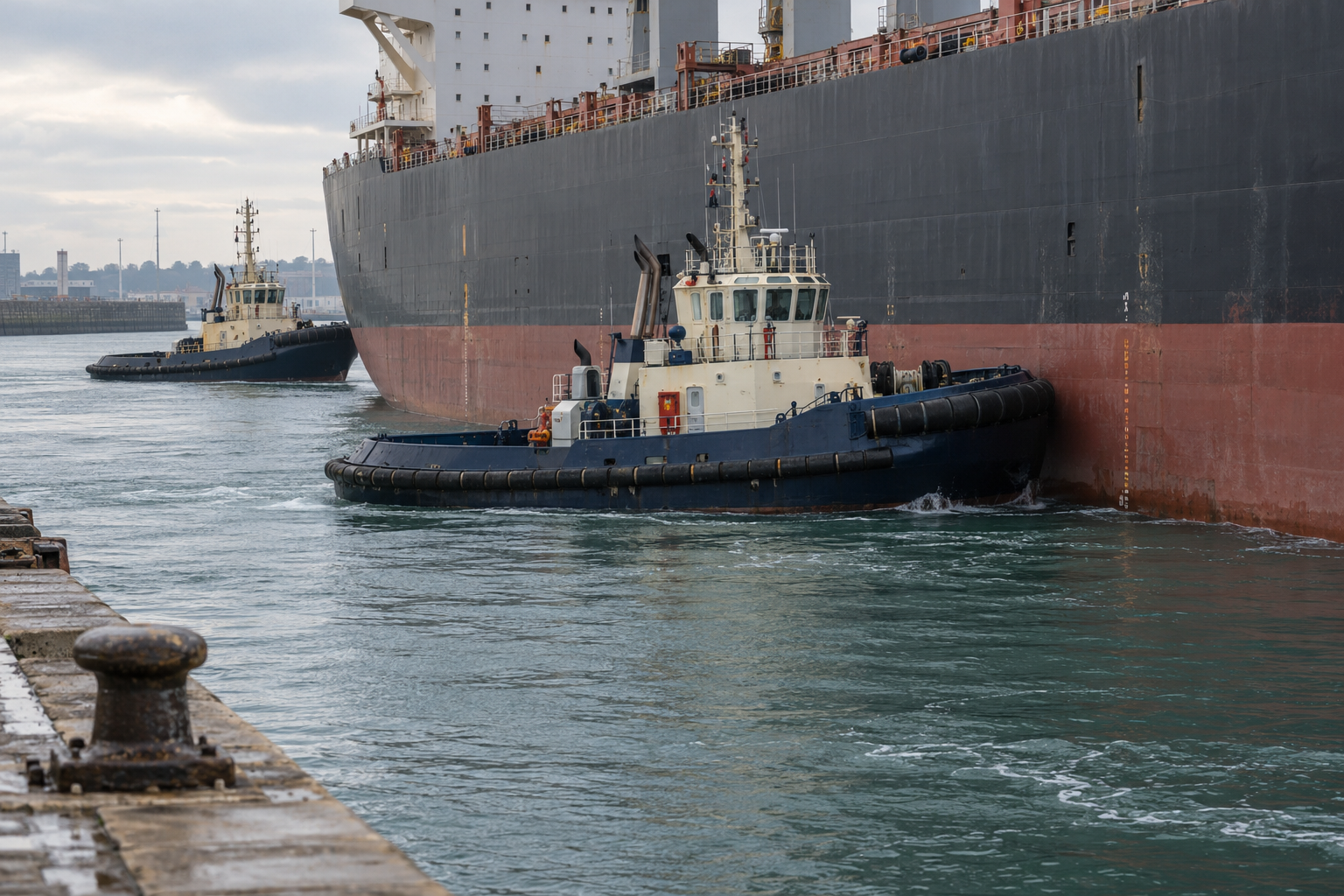
A cargo ship can leave one port heavy with goods and arrive at the next almost empty. When its holds are light, the hull rises; its balance and the depth of its propeller in the water change with it. The crew may pump water into ballast tanks, carry that weight across the sea, then pump it out as the next cargo comes aboard. The water has done a useful job even though no one intended to keep it.
Ballast makes a ship's load adjustable. Filling tanks in the right places can correct a list to one side, set the fore-and-aft trim, maintain enough draft, and keep stresses along the hull within safe limits. It matters to propulsion as well as balance: a propeller working too close to the surface may lose effective immersion. The International Maritime Organization's shipboard training material treats ballast decisions as part of voyage and cargo planning, with the amount taken on or discharged changing as the load changes. Extra water also increases displacement and can cost fuel, so carrying more than the ship needs has a price.
This is a particular kind of water defined by its job. The US Environmental Protection Agency's vessel permit calls ballast water the water and suspended matter taken aboard to control a vessel's trim, draft, stability, or stresses. The same document defines bilgewater as wastewater that collects in the lowest part of the vessel. A ship's potable supply serves another purpose again. Ballast is neither a polite name for bilge nor a drinking-water store, although the regulatory definition concerns how water is used rather than declaring that it can only come from the sea.
A temporary weight with passengers
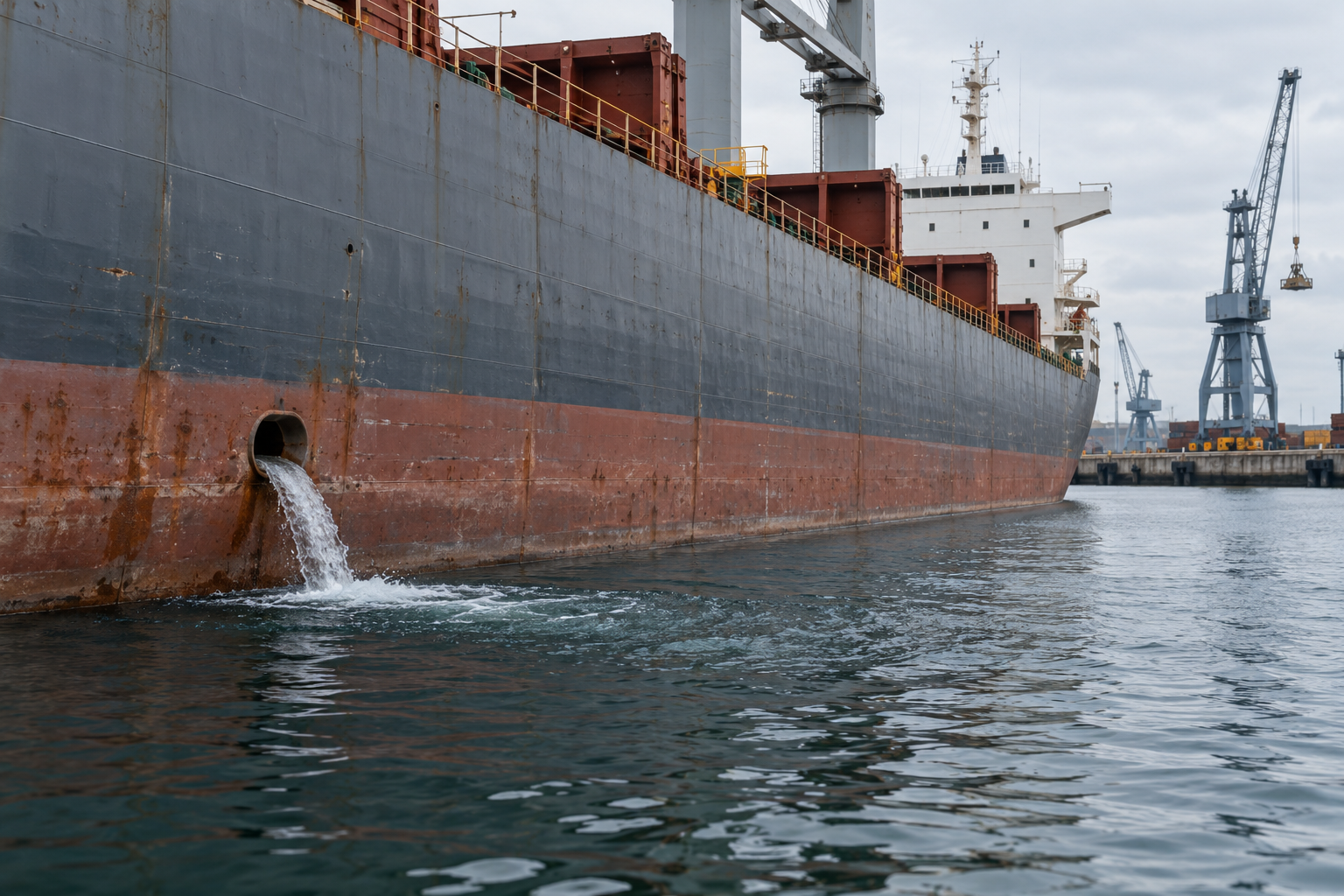
At a berth, pumping water in may seem like a private adjustment inside a steel hull. In fact, the intake can bring in plankton, larvae, eggs, microbes, and suspended sediment from the surrounding water. A tank then becomes a dark, moving connection between two habitats that may otherwise be separated by an ocean. When the ship takes on cargo at its destination, it may need to release that ballast into the receiving port.
In a 1993 study of ballast discharged in Oregon, James Carlton and Jonathan Geller identified 367 taxa in plankton samples from water taken aboard in Japan. That number is a measure of what the sampled water carried, not a count of species that established themselves in Oregon. To found a population, an organism must survive the voyage, be released alive, find a suitable place, and reproduce. Even if most passengers fail at one of those steps, repeated journeys give some another chance.
Sediment complicates the tidy picture of water moving in and out. Material can settle in a ballast tank and stay there after the bulk of the water has been discharged. The 2004 Ballast Water Management Convention therefore addresses sediments as well as water and requires their removal and disposal under each ship's management plan. That detail matters: changing the water is not necessarily the same as emptying the tank of everything it collected.
Two meanings of a successful discharge
The Convention first set out an exchange approach, called D-1. A ship using it replaces at least 95% of the volume of its ballast water. Whenever possible, the exchange is to happen at least 200 nautical miles from land in water at least 200 metres deep; the treaty also specifies a 50-nautical-mile fallback, still in water at least 200 metres deep, where the preferred distance cannot be met. Moving the discharge away from coastal habitats changes where organisms are released and what water replaces them. It does not mean that 95% of organisms are removed or that risk falls by exactly 95%.
Exchange is also a ship operation, not a laboratory rinse. Pumping water out and back in can alter draft, trim, and hull stresses while the vessel is at sea. The Convention allows a master to forgo the specified exchange when adverse weather, design, stress, or equipment trouble makes it a threat to safety, and requires the reason to be recorded. Safety and ecological control have to be considered together.
What survives exchange is not always obvious from the volume pumped. A 2018 study of ballast carried to Valdez, Alaska used DNA sequencing to compare the communities associated with source ports and exchanged water. Exchange changed the mix, but did not reduce the total number of detected kinds of organisms; a weaker source-port signature remained. DNA can persist after an organism dies, so the study does not count viable animals delivered to Valdez. It does show why a water-exchange percentage is an incomplete description of the tank's biological contents.
The second standard, D-2, asks a different question: what may be alive in the water at discharge? For organisms at least 50 micrometres across, the Convention's limit is fewer than 10 viable organisms per cubic metre. It also sets a separate limit for smaller organisms and numerical limits for three indicator microbes. A 2018 IMO amendment phased existing ships into the D-2 requirement by September 2024. Ships can meet it with onboard treatment; systems in the field studies below included filtration paired with ultraviolet light or chemical disinfection. The target is the discharged water, not the amount of water moved through a pump.
What a tank sample can tell us
Treatment has made the journey less hospitable to many organisms, but a fitted system is not a guarantee that every discharge meets the limit. In a study of 29 operational ships arriving in Canada, 14 treated ballast samples clearly exceeded the D-2 limit for the larger organisms. That is a finding about those sampled voyages, not a worldwide failure rate. The researchers lacked paired measurements of organism abundance at intake, so those exceedances alone could not measure how much each system removed.
A later Great Lakes study paired intake and discharge samples from ten ships across eleven events. It found reductions of at least 98% in living organisms in both regulated size classes, while four discharge samples still exceeded the large-organism limit. All four exceedances followed uptake at Hamilton Harbour, where the study linked high initial abundance and filter mesh size to the outcome. These are small, region-specific samples, but together they make the important point clearer than a simple pass or fail: a treatment can remove nearly everything it receives and still leave more viable organisms than the discharge rule permits when the intake is crowded with life.
At the next port, the ship cannot decide whether it needs weight by looking only at its cargo manifest. It must account for the way that weight sits in the hull and for what its pumps will release outside it. Ballast water solves a physical problem on board. Managing it well means remembering that the water retains a history of the place where it entered.
A thought worth keeping?