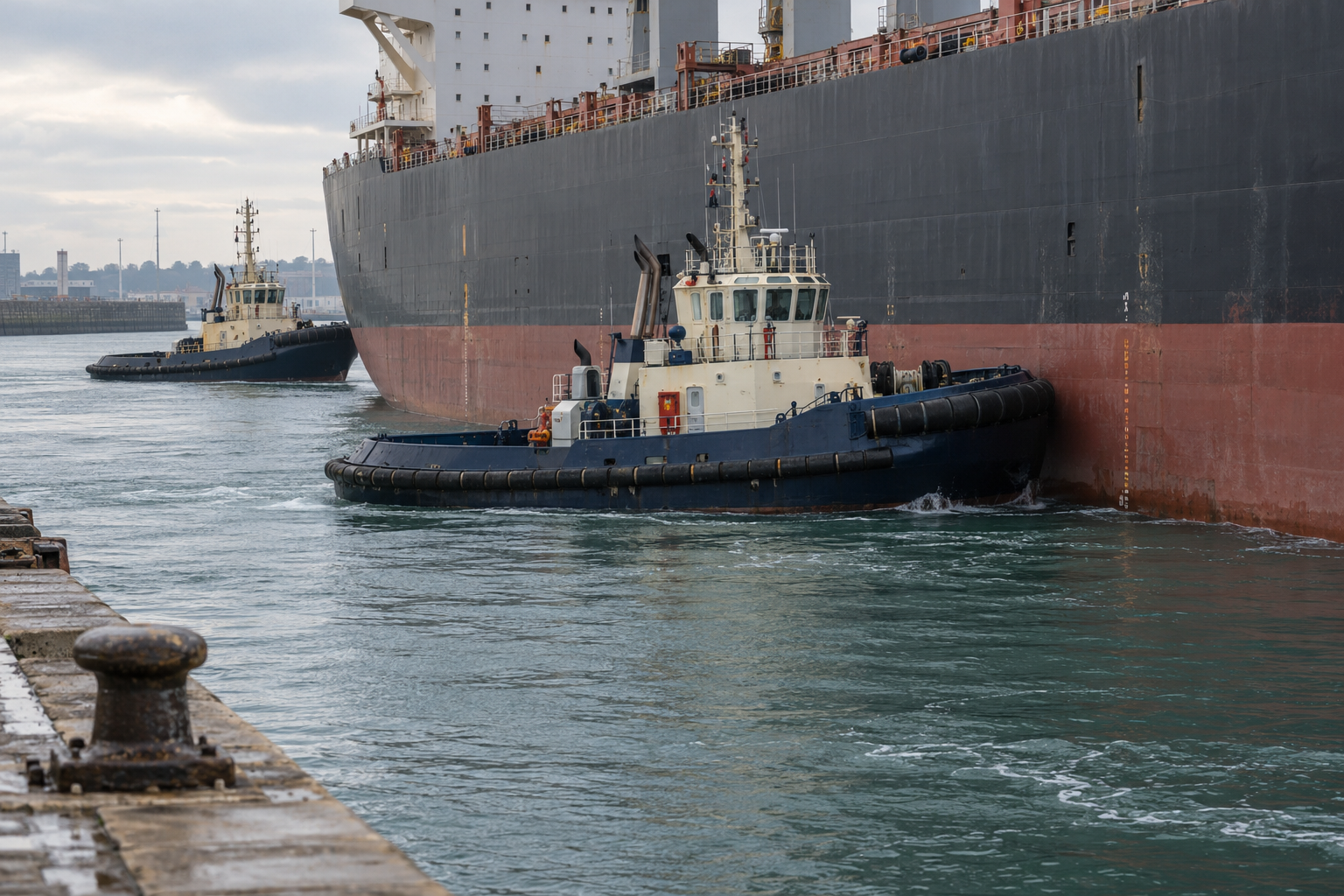
Seen from a quay, a tug can look almost too small for the ship beside it. Its rubber bow is pressed against a steel wall; water wrinkles behind it; the larger vessel seems scarcely to move. That quiet appearance is misleading. In the last part of an approach, the ship must lose speed without losing its chosen heading, turn if the berth requires it, and arrive alongside without carrying more sideways motion than the fenders and mooring arrangements can manage. The tug's job is to put force where the ship needs it during that narrowing sequence.
“Walking speed” is a useful image, not a prescribed speed for making fast or berthing. The safe speed depends on the ship, tug, water, weather and manoeuvre. The Port of London Authority's ship towage code asks the bridge and tug to agree on speed through the water when connecting and during the operation. It also notes that tugs made fast alongside are most effective at minimal ship speed through the water. The important distinction is between a vessel moving slowly enough for the tug to work and a vessel moving so slowly that its own steering becomes weak. Both can be true at once.
A slower ship is not a smaller problem
A rudder works by redirecting water. As the flow past it diminishes, so does the steering force it can produce, although propeller wash, propulsion layout and other manoeuvring aids complicate any simple rule. In a 2002 safety digest, Britain's Marine Accident Investigation Branch describes the cargo ship Xuchanghai approaching Immingham with a tug connected forward and a second securing aft. She was making three knots through the water amid a brisk wind and a four-knot flood. She lost steerage, pointed toward a tanker alongside, and struck it despite corrective helm, engine and bow-tug action. The investigation's lesson is sharply bounded: slower movement can reduce rudder effectiveness, particularly when wind and tide demand a response. It does not mean that more speed is always safer near a berth.
The figures in that account also show why “speed” needs a reference point. A ship's speed through the surrounding water governs much of its rudder behaviour and its interaction with an attending tug. Its progress over the ground matters for how quickly it approaches a fixed quay or another ship. A current can make those two speeds different. Neither instrument reading alone describes the whole manoeuvre. The bridge has to judge a moving hull against stationary structures while the tug master handles the water flowing around both vessels.
The larger ship's mass does not disappear because its speed has fallen. A modest sideways drift can still matter when the available water between hull and berth is small. Wind acts on the exposed side of the ship; current acts below the waterline. A pilot or master may need to counter one of those forces while turning or checking another part of the ship. This is the opening in which the tug becomes valuable: it can supply force from outside the ship, at a chosen place and in a chosen direction. The UK guide to good practice on port and marine facilities accordingly asks harbour towage plans to consider length, draught, manoeuvrability, berth, wind and the tug's capability together, rather than treating vessel size as a complete answer.
The place of the push matters
An assist tug may push against a suitable part of the hull, pull through a towline, or work in another agreed configuration. The UK guide lists pushing, pulling and lines over the bow or stern among the available methods, with the choice depending on the vessels and task. The Larne Port marine manual offers a useful local counterexample to any universal picture: there, tugs are generally engaged for a pushing role rather than to tow. A tug alongside a cargo ship is therefore not necessarily “towing” it forward. It may be holding a bow off the quay, checking a stern's swing, or helping translate the hull sideways.
The geometry is as important as the size of the force. Push near one end of a long hull and you can change its heading as well as its position; apply force elsewhere and the balance changes. Two tugs can be positioned to shape different parts of the same movement. That is an explanation of leverage, not a recipe for placing tugs on an unfamiliar ship. The London code requires the berthing plan to specify tug positions around the hull and identifies which areas are strengthened for pushing. It also asks the bridge to identify the fairleads, chocks, bollards and strong points available for pulling. A powerful tug against the wrong panel or attached to an unsuitable point has not solved the ship's handling problem.
This is why the moment when a tug connects belongs in the plan. The Thames code calls for a rendezvous, an agreed speed, a method for passing and releasing the line, and confirmation that the named tug is fast and ready. A tug at the bow can be exposed to a larger ship's pressure field; MCA guidance on hydrodynamic interaction explains how the forces around a larger vessel may change the smaller tug's drag and tendency to sheer as it moves from the shoulder toward the bow. The forces are not visible from a quay in the way a towline is. They still affect how safely the tug can take its place. In strong tidal conditions, the London code warns, a high share of a tug's power may already be going into holding position before any thrust reaches the assisted ship.
What a bollard-pull number tells you
Ports need a way to compare tugs. The Houston Pilots' 2022 tug matrix classifies assist tugs by bollard pull rather than engine horsepower, while also distinguishing tug designs and a ship's working bow thruster. Bollard pull is a useful measure because it is a force at the towline. A Norwegian Maritime Authority test procedure measures maximum continuous pull against a fixed shore point after the reading stabilises, under specified test conditions. It tells an operator something more directly relevant than the engine's rated power alone.
It is still a test result, not a promise of identical force at every point in a harbour. At Larne, the marine manual notes that forces in everyday moving operations can depart substantially from a static bollard-pull value. Towline tension can also peak above the tug's continuous pull as angle and motion change. The towline, the ship's fittings and the hull supporting them have limits of their own. International Maritime Organization guidance on towing and mooring equipment treats bollards, fairleads, their attachments and the supporting structure as parts of the load path. A number on the tug's specification cannot make that path stronger.
The tug itself has limits, too. A line pulling across it can threaten its stability; the water flowing around a moving ship can alter its handling; a sudden engine order from the ship can change the relationship in seconds. In its 2018 intact-stability standard, the Australian Maritime Safety Authority requires tow-rope arrangements within its scope to minimise overturning force and provide a quick release that works under load. The London code calls for engine orders to be communicated to the tug where operationally possible. These are reasons for the seemingly formal exchanges between bridge and tug, not paperwork added after the important work. The people on the two vessels need to know what force is wanted, where it will act, and when the plan has changed.
The final approach is thus a series of small decisions with large consequences. Does the ship still have enough flow over its rudder? Is the tide using up the tug's reserve merely to hold station? Is the line connected before the turn calls for it? Is a push moving the whole hull sideways or starting an unwanted swing? The Xuchanghai account shows how quickly these questions can become urgent. The port codes show the more ordinary answer: decide the tug's role before the narrow water, keep the speed and instructions intelligible to everyone involved, and adjust to the conditions actually met.
The visible result may be only a few metres of careful movement. That is the work a tug does at walking speed. It gives the ship another way to direct force while the ship gives up way, so that a slow approach remains a controlled one.
A thought worth keeping?